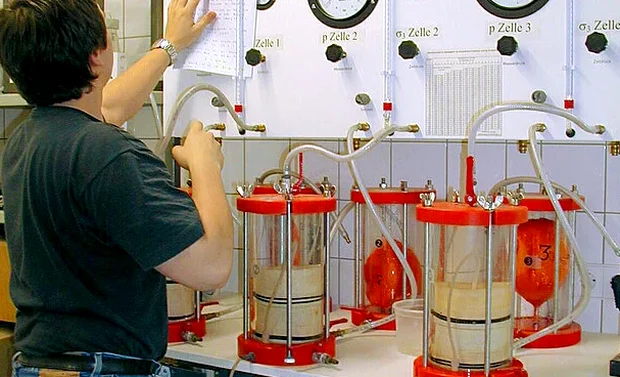
In Corpus Christi, where expansive clay seams alternate with loose beach sands along the Oso Creek floodplain, we often see subgrade failures that trace back to an incomplete understanding of the soil's bearing capacity under moisture intrusion. The laboratory CBR test provides that critical number, correlating the soaked strength of a compacted specimen to the unsoaked baseline, which is exactly what the Texas Gulf Coast's seasonal groundwater swings demand. Unlike a field density check, this test quantifies how a subgrade will behave after saturation—a scenario that plays out every hurricane season from June to November. We run the procedure following ASTM D1883-21, compacting samples at optimum moisture from your Proctor data and soaking them for 96 hours before penetration. For projects east of SH 358 where the Beaumont Formation clays dominate, pairing this with an Atterberg limits evaluation helps us anticipate the swell potential that can undermine even a well-compacted base course.
A soaked CBR below 5% in Corpus Christi subgrade means you are designing for a pavement that will rut before the first heavy rain.
Local geotechnical context
Corpus Christi sits on a geological patchwork of Holocene alluvium, Pleistocene-age Beaumont clay, and windblown Ingleside sand, meaning two lots half a mile apart can deliver CBR values that differ by a factor of three. We have tested samples from the Flour Bluff area that registered soaked CBRs below 3%, while material from a Calallen site exceeded 15% under the same compactive effort—a range that forces entirely different pavement structural numbers in the AASHTO 1993 design equation. The bigger risk is assuming a CBR from a borrow source without accounting for the compaction achievable with the contractor's rollers on a hot August afternoon when the moisture content evaporates faster than the sheepsfoot can chase it. We see this mismatch most clearly in residential streets built on the Oso Creek lowlands, where post-construction saturation drops the effective CBR into the sub-4% range and the asphalt mat begins cracking within two wet-dry cycles. A defensible CBR test program, executed with local moisture-density targets, prevents the kind of pavement rehabilitation that drains an HOA budget in under five years.