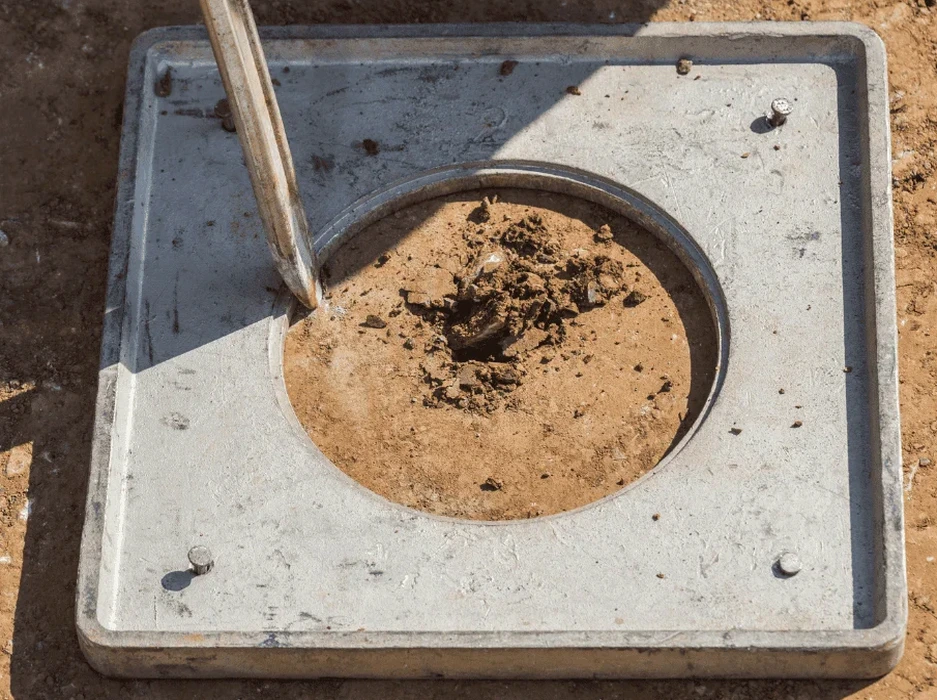
The soil profile east of Oso Creek tells a completely different story than what you find out toward Calallen. Closer to the bay, you are dealing with saturated loose sands and silty deposits laid down by the Nueces River floodplain and coastal processes, while the western terraces sit on older, overconsolidated clays. This contrast matters enormously when a project triggers a seismic site class determination under ASCE 7. In the downtown marina district and along North Beach, the groundwater table often sits within five feet of grade, which immediately raises the liquefaction screening flag during a Phase II investigation. We run the analysis using SPT blow counts corrected for fines content per the NCEER/Youd-Idriss framework, because a raw N-value without the fines correction can overstate the factor of safety in silty sands common to Corpus Christi's barrier island and bay margin geology. For deeper stratigraphy or when the client needs a continuous profile without disturbing the sample, we coordinate with a CPT test program to get tip resistance and sleeve friction data that feeds directly into the Robertson-based liquefaction triggering correlations, which are less sensitive to operator variability than SPT hammer energy.
Applying the fines content correction to SPT blow counts in Corpus Christi's silty bay sands often moves the factor of safety from below 1.0 to above 1.3, changing the entire mitigation strategy.
Regulatory framework
ASCE 7-22 Chapter 11 & 20 (Seismic Design & Site-Specific Procedures), IBC 2021 Section 1613 (Earthquake Loads), ASTM D1586-18 (Standard Test Method for Standard Penetration Test), ASTM D2487-17 (Standard Practice for Classification of Soils for Engineering Purposes), NCEER Workshop Recommendations (Youd & Idriss, 2001)
Questions and answers
At what depth does IBC require liquefaction screening for a Corpus Christi site?
The IBC references ASCE 7, which triggers a liquefaction evaluation when the groundwater table is within 50 feet of the ground surface and the soil profile contains loose to medium-dense sands with an SPT N60 below 15 blows per foot. In Corpus Christi's bay margin areas, the water table is often encountered at 3 to 8 feet, so the screening applies to virtually any project east of the Oso Creek drainage divide.
What is the typical cost range for a liquefaction analysis tied to an SPT drilling program?
Can you evaluate liquefaction using CPT soundings instead of SPT borings?
Yes. CPT-based triggering using the Robertson and Wride normalized soil behavior type index is often more repeatable in the low-confinement upper 15 feet where SPT hammer energy variability can be high. We run both methods when the project stratigraphy includes thin silt seams that are difficult to capture with a split spoon sampler.
How do you account for the fines content in Corpus Christi's silty sands?
We perform a full wash-sieve analysis on every split spoon sample flagged for liquefaction assessment, determining the percent passing the #200 sieve per ASTM D2487. That fines content is applied to the NCEER recommended correction curves that shift the cyclic resistance ratio upward, which is especially important for the silty sand facies common in the Nueces River alluvium and the barrier island washover deposits.