← Home · Laboratory

Proctor Test (Standard & Modified) in Corpus Christi

Together, we solve the challenges of tomorrow.

LEARN MORE →

Corpus Christi grew from a frontier trading post into a major port largely by reshaping the low-lying coastal plain—an effort that still depends on getting the dirt right. The thick Beaumont Formation clays and loose Holocene sands that underlie the city respond dramatically to small changes in moisture, which is where the Proctor test becomes indispensable. Whether the spec calls for ASTM D698 Standard effort or the heavier D1557 Modified procedure, the goal is the same: pin down the maximum dry density and optimum moisture content that will keep a subgrade from failing under South Texas heat and occasional deluge. Because the city’s infrastructure sits barely 10 to 30 feet above sea level, even a half-percent deviation in compaction can invite differential settlement.

Our laboratory runs both procedures on material pulled directly from the project footprint and delivers the moisture-density curve engineers need for CBR testing for roads and for validating flexible pavement designs that hold up against heavy truck traffic on IH-37 and beyond.

In Corpus Christi’s expansive clays, hitting optimum moisture is the difference between a pavement that lasts 20 years and one that starts cracking in the first dry summer.
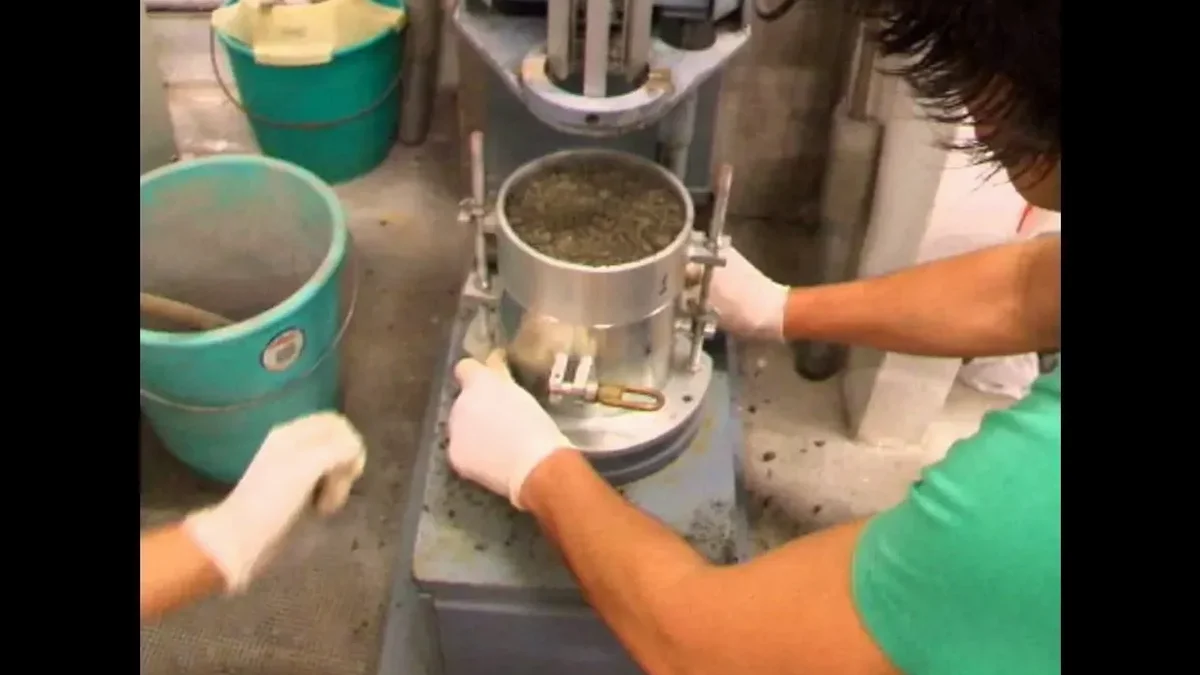
Methodology and scope

The geology here is dominated by Pleistocene-age clays that swell when wet and shrink into deep cracks during drought, while the near-surface sands can be quite silty. Groundwater often sits less than 3 meters below grade across much of the city, which means moisture control during compaction is a constant battle. A proper Proctor curve gives the fieldwork a target: the lab report specifies exactly how much water to add on the pad and how many passes the roller needs to hit 95 or 98 percent relative compaction. We run three compaction points as standard and can add a fourth to tighten the curve when the soil is sensitive.

For sites where fill is being imported, the Proctor test works hand-in-hand with Atterberg limits to flag borderline materials, and with sand cone density to verify compaction in the field. Every result is backed by our ISO 17025-accredited lab procedures, which follow ASTM D698-12(2021) and ASTM D1557-12(2021) to the letter. The report includes the zero-air-voids curve and saturation lines for immediate QC interpretation.
Proctor Test (Standard & Modified) in Corpus Christi
Technical reference image — Corpus Christi

Local geotechnical context

The coastal humidity that defines Corpus Christi life also complicates soil compaction in ways that a generic Proctor number cannot capture. Clay subgrades compacted to spec in March may lose strength by August if the underlying moisture regime shifts, and the region’s frequent afternoon downpours can saturate an open excavation in minutes. Skipping the Proctor step—or running it on a grab sample that doesn’t represent the actual lift—leads to rutting, edge heave, and pavement alligator cracking within the first two years.

For critical infrastructure—think port container yards, flood-control levees, and school foundations—the cost of a single failed compaction zone dwarfs the lab fee. Our team has seen contractors lose weeks reworking fills simply because the lab curve was generated from a different borrow source than the one delivered to the site. We therefore insist on a fresh Proctor for each significant change in material type, as recommended by TxDOT’s Standard Specifications for Construction and Maintenance of Highways, Streets, and Bridges.

Need a geotechnical assessment?

Reply within 24h.

Email: contact@geotechnical-engineering1.org

Technical data

ParameterTypical value
Applicable standardsASTM D698-12(2021), ASTM D1557-12(2021)
Standard Proctor compactive effort12,400 ft-lbf/ft³ (600 kN-m/m³)
Modified Proctor compactive effort56,000 ft-lbf/ft³ (2,700 kN-m/m³)
Mold sizes available4-inch and 6-inch diameter
Typical reported parametersMaximum dry density (pcf or kg/m³), optimum moisture content (%), zero-air-voids curve
Sample preparationDried and processed per Method A, B, or C as appropriate for gradation
Typical target compaction in Corpus Christi95-98% relative compaction for subgrade and base course
Lab temperature control23 ± 2°C per ASTM conditioning requirements

Related services

01

Standard Proctor (ASTM D698)

The baseline compaction test for residential slabs, landscape berms, and shallow utility trenches in Corpus Christi. Uses a 5.5-lb hammer dropped 12 inches in three layers.

02

Modified Proctor (ASTM D1557)

Higher-energy compaction for arterial roads, bridge approaches, and heavy industrial pads. A 10-lb hammer dropped 18 inches in five layers mimics the effort of modern vibratory rollers.

03

One-Point Proctor (field quick check)

A rapid screening tool used when material changes mid-shift. Correlates a single compacted point to the full curve so the compaction crew can adjust moisture without waiting for the full lab run.

Regulatory framework

ASTM D698-12(2021), ASTM D1557-12(2021), TxDOT Tex-113-E / Tex-114-E, ASTM D4718 (oversize correction)

Questions and answers

How much does a Proctor test cost in Corpus Christi?
When should I use Modified Proctor instead of Standard?

The Modified Proctor applies when the project will see heavy compaction equipment and high axle loads—think TxDOT roadways, port terminal pavements, or commercial building pads with strict settlement tolerances. Standard Proctor is generally adequate for low-rise residential, landscaping fills, and shallow utility trenches where the compactive effort in the field is lower.

How many Proctors do I need for a single job?

TxDOT and ASTM guidance recommends at least one Proctor per distinct material type encountered. If the borrow source changes, the soil color shifts noticeably, or the Atterberg limits move more than about 5 points, a new Proctor should be run. For a typical Corpus Christi subdivision, expect 2-4 Proctors depending on the uniformity of the on-site clays and any imported select fill.

Location and service area

We serve projects across Corpus Christi and surrounding areas.

View larger map