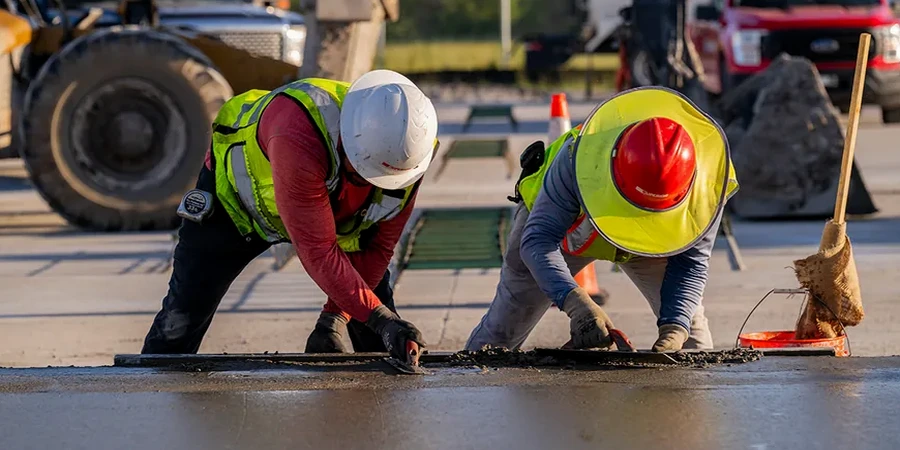
With a population pushing 317,000 and sitting right on the western Gulf Coastal Plain, Corpus Christi deals with a unique set of pavement challenges that you don't see up in the Hill Country. The city sits barely 7 feet above sea level on average, and the underlying Beaumont Formation clays are notorious for volume swings tied to seasonal moisture. We've pulled pavement cores along I-37 and SH 358 where subgrade stiffness dropped 40 percent between August and January—just from the clay wetting and drying cycles. That's the reality here. Rigid pavement design isn't just about concrete thickness; it's about anticipating what that fat clay is going to do over the next 30 years, and designing a slab that can handle it without curling, faulting, or cracking at the joints. We lean heavily on the PCA method and ACI 360R when the geotechnical report flags PI values above 30, which happens more often than not in Nueces County. When the project sits on the western edge of town closer to the Calallen lignite seams, we also run sulfate and pH panels on the subgrade before specifying the cementitious binder, because a sulfate attack will eat a standard Type I cement slab in under a decade if you ignore it. The port and industrial corridors along the ship channel add another layer: heavy forklift traffic, container stacking loads, and occasional hydrocarbon spills mean the concrete mix design and joint detailing have to be just as tough as the subgrade preparation. For projects with marginal subgrade, we often recommend a treated base course or a geogrid-stabilized layer, and we coordinate the CBR testing for road subgrades when the owner wants to benchmark the improvement against the TxDOT specification thresholds.
A rigid pavement on Beaumont clay without a sulfate-resistant binder is a 10-year slab, not a 30-year one—and the Gulf Coast doesn't forgive shortcuts on the subgrade.
Methodology and scope
The geology under Corpus Christi is dominated by the Pleistocene-age Beaumont Clay—a stiff to very stiff, tan to gray fat clay with liquid limits routinely above 50 and PI values between 25 and 40. That's a CH material under USCS, and it's expansive. We've measured free swell values exceeding 8 percent in samples from the south side near Oso Bay, which puts the subgrade squarely in the moderate-to-high expansion potential category per TxDOT Test Method Tex-124-E. What that means for rigid pavement design is that you can't just drop a 6-inch slab on 4 inches of flex base and walk away. You need a moisture-conditioned, lime-treated subgrade at minimum 12 inches thick, or a full-depth asphalt interlayer if the owner wants to avoid chemical stabilization. The sulfate question is critical here—parts of the city, especially east of Everhart Road, have soil sulfate concentrations above 3,000 ppm, which forces us to specify sulfate-resistant cement (ASTM C150 Type V) or blended cements with low tricalcium aluminate content. We learned that lesson the hard way on a warehouse project on Agnes Street back in 2011. Joint design in these clays follows ACI 325.12R, with contraction joint spacing kept tight—typically 12 to 15 feet for a 6-inch slab—to control curling stresses. Load transfer at joints is non-negotiable; we specify dowel bars for all industrial slabs and heavy-vehicle pavements, sized per the PCA method and aligned with TxDOT standard sheets. The concrete mix itself needs a maximum water-cement ratio of 0.45 for exterior slabs in the Corpus Christi exposure zone, which puts us in the S1 exposure class per ACI 318 with the added kicker of airborne chlorides from the Gulf. A 4,500 psi minimum 28-day compressive strength is our baseline, but we push to 5,000 psi when deicing chemicals or occasional saltwater flooding are expected.
Local considerations
We inspected a tilt-wall distribution center off Agnes Street where the parking lot slab had heaved 1.5 inches at the center joints within three years of placement. The original design had ignored the sulfate report and used standard Type I cement on a 4-inch untreated flex base over Beaumont clay with a PI of 38. The sulfate attack had softened the cement paste at the joints, and the expansive clay had lifted the entire slab enough to misalign the dock levelers. Repair meant full-depth patching of 40 percent of the slab area and retrofitting the subgrade with lime injection—a six-figure fix that could have been avoided with a proper geotechnical investigation and a sulfate-resistant mix design. On the other end of the spectrum, we saw a well-executed rigid pavement at the Port of Corpus Christi where the engineering team had specified a 10-inch slab with doweled contraction joints, a 12-inch cement-stabilized subgrade, and Type V cement throughout. After eight years of container handler traffic and occasional ethylene glycol spills, the slab showed only minor surface scaling and zero faulting at the joints. The difference between these two outcomes is almost always the geotechnical input that feeds the pavement design—skip the soil testing, and you're gambling with a million-dollar asset.
Applicable standards
ASTM C150 – Standard Specification for Portland Cement (Type V for sulfate resistance), ACI 360R – Guide to Design of Slabs-on-Ground, ACI 325.12R – Guide for Design of Jointed Concrete Pavements, TxDOT Pavement Design Guide (Rigid Pavement Section), PCA – Thickness Design for Concrete Highway and Street Pavements, ASTM C1580 – Standard Test Method for Water-Soluble Sulfate in Soil
Frequently asked questions
How much does a rigid pavement design cost for a project in Corpus Christi?
For a typical industrial or commercial rigid pavement design in the Corpus Christi area—including subgrade investigation, laboratory testing, k-value determination, slab thickness calculations, and signed/sealed engineering drawings—the design fee ranges from US$1,760 to US$6,280 depending on the project size and complexity. A small parking lot or driveway may fall at the lower end, while a port container yard or a distribution center with heavy axle loads, sulfate testing, and detailed joint layout drawings will push toward the upper end. The fee always includes the geotechnical field work, the concrete mix specification, and the PCA-based thickness design report.
What makes Corpus Christi subgrades so challenging for concrete pavements?
The Beaumont Formation clay that underlies most of the city is a high-plasticity fat clay (CH) with liquid limits above 50 and PI values between 25 and 40. It swells when wet and shrinks when dry, creating volume changes that can lift or crack a rigid slab if the subgrade isn't treated. On top of that, soil sulfates are common—especially east of Everhart Road and near the old Calallen lignite deposits—and they'll attack standard Portland cement paste over time. A proper rigid pavement design here has to address both the expansive clay movement and the sulfate reactivity, which is why we default to lime or cement treatment and sulfate-resistant binders.
Do you follow TxDOT or ACI standards for rigid pavement design in Corpus Christi?
We use both, and we select the applicable standard based on the project type. For public roadway projects and TxDOT-funded work, we follow the TxDOT Pavement Design Guide and the relevant standard specification items (Item 360 for concrete pavement). For private industrial slabs, port pavements, and commercial parking lots, we typically rely on the PCA thickness design method and ACI 360R (slabs-on-ground) combined with ACI 325.12R (jointed concrete pavements). In both cases, the concrete mix design references ACI 318 for exposure classes, and we always run ASTM C1580 sulfate tests on the subgrade before specifying the cement type.