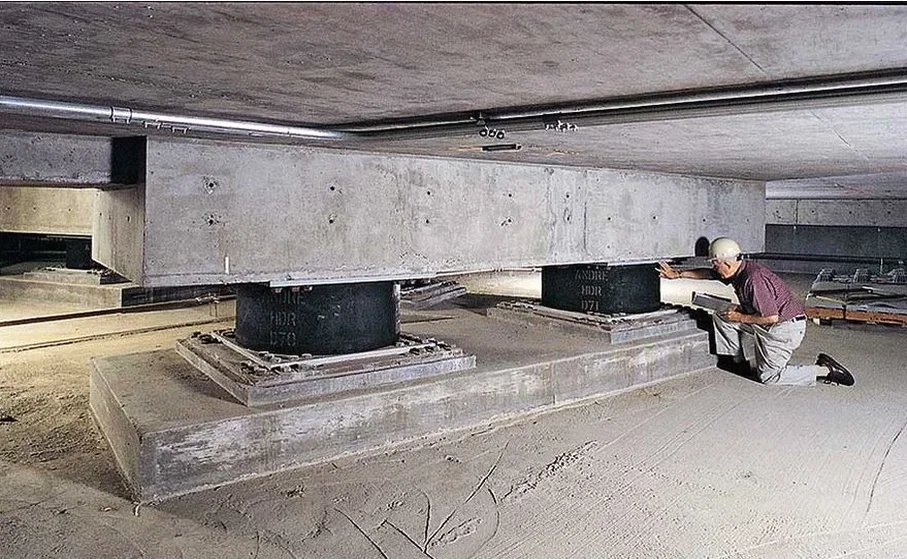
Corpus Christi’s growth from a frontier trading post in the 1830s to a major Gulf Coast energy hub has been shaped by its geography—a low-lying coastal plain where deep, compressible clay formations predominate. This same geology that made the city navigable for commerce also makes it vulnerable to long-period ground motion, particularly from distant subduction events in the Gulf or the New Madrid zone. Base isolation changes the equation. By decoupling the superstructure from the ground, we reduce seismic force transmission by 60 to 80 percent. For buildings housing critical operations near the port, the seismic microzonation studies we run first establish the spectral demand, and from there the isolator parameters are tuned to the site-specific hazard rather than a generic code spectrum. That matters here, where soil amplification on the Beaumont Formation can be significant.
A properly tuned base isolation system in Corpus Christi soil conditions cuts spectral acceleration at the building's fundamental period by over 50 percent compared to a fixed-base design.
Local considerations
ASCE 7-22 Chapter 17 governs seismic isolation analysis in the United States, and the IBC adopts it with Texas-specific amendments. Corpus Christi falls in a moderate seismicity zone by USGS maps, but the risk profile is deceptive. The city’s deep soft clay deposits—the Beaumont Formation extends over 30 meters in many locations—amplify long-period energy that fixed-base structures cannot easily dissipate. If the isolator displacement capacity is underestimated, the building can pound against the moat wall during a maximum considered earthquake, transferring forces directly into the superstructure. That is a failure mode we design out from day one. The other risk is utility connections. Gas, water, and electrical lines crossing the isolation plane must accommodate the full displacement without rupture. We specify flexible couplings tested to ISO 10855 for offshore-derived hardware that handles the corrosive salt-air environment. Coastal flooding adds another layer: the isolation pit must remain watertight during a 500-year storm surge scenario, or the bearings lose functionality.
Frequently asked questions
What does base isolation design cost for a Corpus Christi building project?
For a mid-rise structure in Corpus Christi, the full engineering package—including nonlinear analysis, isolator specification, and testing oversight—typically falls in the US$4,440 to US$8,460 range. The final figure depends on building footprint, number of isolators, and whether peer review is required by the jurisdiction. The isolator hardware cost is separate and quoted by the manufacturer based on our specifications.
Does base isolation work on the soft clay soils found in Corpus Christi?
Yes, and it is precisely on these Site Class D and E soils where isolation provides the greatest benefit. The Beaumont Formation clays amplify long-period motion that fixed-base structures struggle with. By shifting the building's period to 2 seconds or beyond, we move it past the amplified part of the spectrum. The foundation itself must be a rigid mat or interconnected footings to ensure all isolators move in phase—that is a critical design requirement on soft soil.
How long does the design and approval process take?
A typical base isolation design package for a Corpus Christi project takes 8 to 12 weeks from contract award to stamped drawings. That includes site-specific ground motion selection, nonlinear modeling, isolator sizing, and preparation of the peer review package. If the project is on an accelerated schedule, we can overlap analysis phases and deliver preliminary isolator parameters in 4 to 5 weeks so the structural team can proceed with superstructure design.