← Home · Ground improvement

Vibrocompaction Design in Corpus Christi: Stabilizing Coastal and Alluvial Soils

Together, we solve the challenges of tomorrow.

LEARN MORE →

Corpus Christi’s transformation from a small trading post in the 1830s to a major petrochemical and export hub has pushed infrastructure onto challenging coastal plain deposits. As the city expanded across the Nueces and Oso floodplains, builders encountered loose, saturated sands that are notoriously difficult to compact with surface rollers. We design vibrocompaction programs that densify these liquefiable layers at depth, giving you a stable working platform for tanks, turbines, and heavy industrial structures. The process is validated with pre- and post-treatment CPT soundings, and we often tie the execution to a grain-size analysis program so gradation shifts are tracked from the start. For very soft interbeds, our team evaluates whether stone columns should supplement the densification grid without delaying the schedule.

A well-designed vibrocompaction grid in Corpus Christi can raise relative density from 40 to over 75 percent in a single shift, eliminating deep foundation overruns.

Methodology and scope

The shallow subsurface under much of Corpus Christi is dominated by the Beaumont Formation: interbedded clays and silty fine sands with a groundwater table that sits barely 1.5 to 2 meters below grade. This means standard vibrocompaction must contend with high pore pressure buildup and potential sand boils if the water flow isn’t managed. Our designs specify a triangular probe pattern at 2.4 to 3.0 meter spacing, using electric or hydraulic vibrators capable of 130–180 kW, and we set hold times based on real-time ammeter readings so each penetration reaches the target relative density of 70–85 percent. Where the Beaumont clays pinch out, we adjust the grid on the fly: the method is tolerant, but only if the frequency and duration are tuned to the local grain size envelope. Post-treatment verification relies on SPT or CPT correlations to confirm that the soil mass meets the performance criteria set in the project’s geotechnical baseline report, and we frequently cross-check results with laboratory Proctor tests on the upper fill layer to ensure the entire profile is competent.
Vibrocompaction Design in Corpus Christi: Stabilizing Coastal and Alluvial Soils
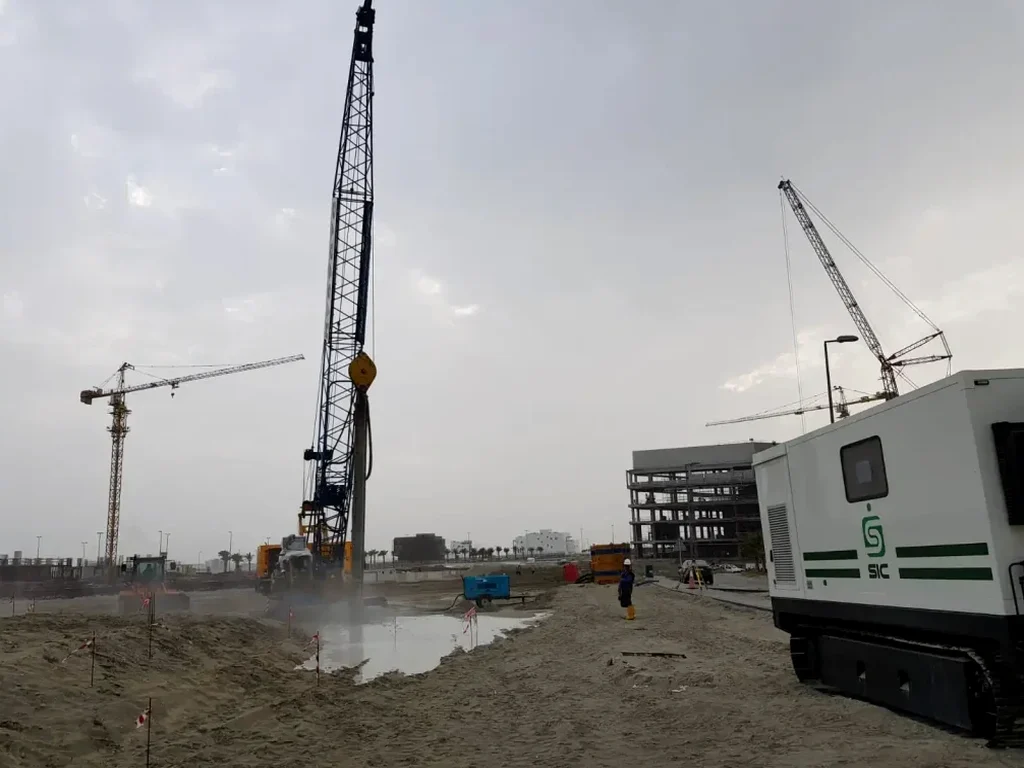
Technical reference image — Corpus Christi

Local considerations

Corpus Christi sits at an elevation of just 2 meters above sea level, with a metropolitan population exceeding 420,000, placing critical infrastructure directly in the path of hurricane storm surge and seismic-induced liquefaction. The last significant felt event, the 2011 M4.8 earthquake near Fashing, was a reminder that the Gulf Coast is not seismically inert. Without deep densification, loose alluvial sands can lose over 60 percent of their bearing capacity when pore pressure spikes during a design-level event. Vibrocompaction directly mitigates this mechanism by rearranging grains into a denser state, but the design must account for the energy dissipation that occurs in silty sands. Our reports address residual liquefaction risk with post-treatment settlement estimates and, where needed, specify perimeter drains to handle excess water during the compaction process, keeping your site on schedule even when the water table is high.

Need a geotechnical assessment?

Reply within 24h.

Email: contact@geotechnical-engineering1.org

Technical parameters

ParameterTypical value
Typical treatment depthUp to 18 m below working platform
Probe spacing (triangular grid)2.0 – 3.5 m depending on silt content
Vibrator power range130 – 180 kW electric or hydraulic
Target relative density (Dr)70 – 85% per project spec
Pre/post verification methodCPT (ASTM D5778) or SPT (ASTM D1586)
Applicable soil typeClean to silty sands (fines < 15%)
Groundwater influenceHigh water table requires controlled flush water

Associated technical services

01

Liquefaction Triggering Analysis & Treatment Criteria

We run CPT-based triggering analyses using the Boulanger-Idriss (2014) procedure to establish the depth and thickness of liquefiable layers, then back-calculate the post-treatment SPT or CPT target values required to achieve a factor of safety above 1.2 for your design earthquake.

02

Grid Design & Construction Specifications

Full design package including probe layout, vibrator selection, amperage hold times, and water flush rates. Specifications are written to be bid-ready, with clear acceptance criteria tied to relative density and allowable settlement.

03

QA/QC Field Oversight & Post-Treatment Verification

Our engineers supervise the trial zone execution and adjust parameters in real time. Post-treatment verification includes a statistical comparison of pre- and post-densification CPT soundings, plus laboratory index tests to confirm no fines migration has occurred.

Applicable standards

ASTM D6066-11: Standard Practice for Determining the Normalized Penetration Resistance of Sands for Evaluation of Liquefaction Potential, ASCE 7-22: Minimum Design Loads and Associated Criteria for Buildings and Other Structures, ASTM D5778-20: Standard Test Method for Electronic Friction Cone and Piezocone Penetration Testing of Soils

Frequently asked questions

What is the typical cost range for a vibrocompaction design package in Corpus Christi?

Design fees for a medium-scale industrial lot in the Corpus Christi area generally run between US$1,660 and US$5,940, depending on the treated footprint, depth of liquefiable material, and number of verification borings required by the geotechnical baseline report.

How does the high water table in Corpus Christi affect vibrocompaction?

A shallow water table actually helps vibrocompaction by reducing intergranular friction, but it requires careful control of flush water to prevent sand boils. Our designs include a water management protocol that keeps the working platform stable while the probe reaches design depth.

Can vibrocompaction be used on the Beaumont Formation clays found in the area?

Vibrocompaction is only effective in granular soils with fines content below about 15 percent. For the cohesive Beaumont clays, we recommend alternative ground improvement such as stone columns or surcharge with wick drains, which we can design as part of a combined treatment plan.

How long does the design and permitting phase take before mobilization?

A typical design cycle runs three to four weeks: one week for site characterization and liquefaction analysis, one week for grid layout and specification writing, and a final week for client review and City of Corpus Christi permit coordination, assuming CPT data is already available.
Location and service area

We serve projects across Corpus Christi and surrounding areas.

View larger map